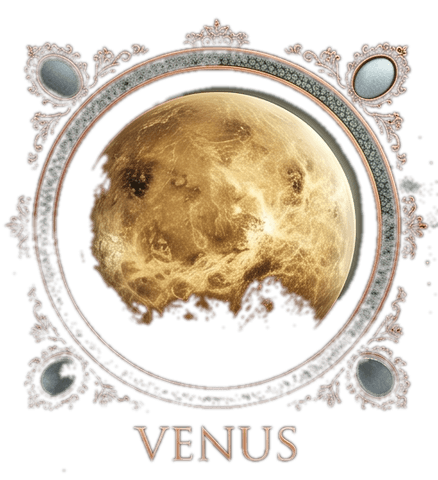
Venus
Shukra (शुक्र) — Water (Jala) Element
The divine artist — karaka of love, beauty, and marriage.
Astronomical Data
- Distance from Sun
- 108.2 million km
- Diameter
- 12,104 km
- Revolution Period
- 225 Earth days
- Rotation Period
- 243 days (retrograde)
- Moons
- 0
Vedic Significations
Vedic Essentials
- Guna
- Rajas
- Presiding Deity
- Shukracharya
- Gemstone
- Diamond (Heera)
- Metal
- Silver
Sign Dignity
Own Signs (Swakshetra)
Taurus & Libra
Exaltation (Uccha)
Pisces (27°)
Debilitation (Neecha)
Virgo
VELS reads exclusively under the sidereal (Nirayana) zodiac and whole-sign houses — the same framework our chart engine uses to compute your own placements. Readers coming from tropical Western astrology should note that a planet's sign here refers to its sidereal position, which typically differs from its tropical sign by roughly 24°.
Navagraha Stotra — Shukra
हिमकुन्दमृणालाभं दैत्यानां परमं गुरुम्। सर्वशास्त्रप्रवक्तारं भार्गवं प्रणमाम्यहम्॥
Himakunda mṛṇālābhaṁ daityānāṁ paramaṁ gurum | Sarvaśāstra pravaktāraṁ bhārgavaṁ praṇamāmyaham ||
I bow to Venus, white as snow and jasmine, supreme teacher of demons, master of all scriptures, son of Bhrigu.
The Divine Journey of Shukra
Where Brihaspati chose to guide the Devas, Shukracharya — son of Sage Bhrigu — chose to become guru to the Asuras, the very beings conventionally cast as the gods' opponents. Classical tradition does not read this as a moral failing so much as a demonstration of Venus's essential nature: beauty, wisdom, and grace extend even to those cast out by convention, without waiting for permission.
Shukra is credited with Sanjeevani Vidya, the knowledge of reviving the dead — a power unique to him among the grahas, and one that ties Venus to creative and regenerative force broadly, not only to romance in the narrow sense. Where Mars is raw desire and Mercury is factual communication, Venus is the graha that refines desire into love and communication into art; astrologers, artists, designers, and diplomats are its traditional professions.
A well-known myth explains why Venus is visible only as the morning or evening star and never at midnight: when Vishnu, disguised as the dwarf Vamana, tricked the demon king Bali out of his kingdom, Shukra recognized the deception and tried to physically block the ritual water pledge — transforming into a bee to plug the vessel's spout. Vishnu pierced the blockage with a blade of grass, and in the same stroke pierced Shukra's eye. Venus has appeared partially obscured, though still the brightest object in the sky after the Sun and Moon, ever since.
Venus rules two signs, Taurus and Libra, is exalted in Pisces — love's most expansive form, compassion without a specific object — and debilitated in Virgo, where close analysis and criticism are read as working against Venus's need for acceptance and ease. Friday, Shukravaar, remains the traditional day associated with romance, creativity, and pleasure.
As karaka of marriage, Venus's condition is central to matchmaking analysis, and in medical astrology it governs the reproductive system and kidneys — organs of creation and of purification. Classical remedies for an afflicted Venus — wearing diamond or white sapphire, observing Friday fasts — are aimed less at suppressing desire than at refining it: the same principle behind bhakti traditions like Radha–Krishna devotion, which treat romantic longing as a legitimate doorway toward the divine rather than a distraction from it.
Discover Venus in your own birth chart — its placement, aspects, and dashas.
Get My Free Birth Chart