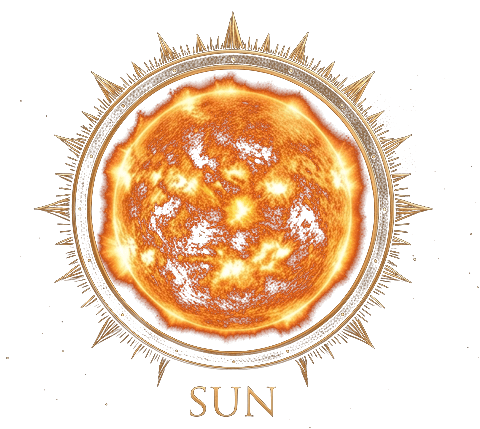
Sun
Surya (सूर्य) — Fire (Agni) Element
The soul's own light — karaka of authority, vitality, and the father.
Astronomical Data
- Distance from Sun
- 0 km (is the Sun)
- Diameter
- 1.39 million km
- Revolution Period
- N/A (center of the solar system)
- Rotation Period
- 25–35 days
- Moons
- 0
Vedic Significations
Vedic Essentials
- Guna
- Sattva
- Presiding Deity
- Surya Deva
- Gemstone
- Ruby (Manikya)
- Metal
- Gold
Sign Dignity
Own Signs (Swakshetra)
Leo
Exaltation (Uccha)
Aries (10°)
Debilitation (Neecha)
Libra
VELS reads exclusively under the sidereal (Nirayana) zodiac and whole-sign houses — the same framework our chart engine uses to compute your own placements. Readers coming from tropical Western astrology should note that a planet's sign here refers to its sidereal position, which typically differs from its tropical sign by roughly 24°.
Navagraha Stotra — Surya
जपाकुसुमसंकाशं काश्यपेयं महाद्युतिम्। तमोऽरिं सर्वपापघ्नं प्रणतोऽस्मि दिवाकरम्॥
Japākusuma saṅkāśaṁ kāśyapeyaṁ mahādyutim | Tamo'riṁ sarvapāpaghnaṁ praṇato'smi divākaram ||
I bow to the Sun, who shines like the hibiscus flower, son of Kashyapa, of great brilliance, enemy of darkness and destroyer of all sins.
The Divine Journey of Surya
Puranic tradition traces Surya's origin to Sage Kashyapa and his wife Aditi, mother of the Adityas. Where the other eight grahas orbit and reflect, the Sun alone generates its own light — a distinction Vedic astrology treats as more than astronomical trivia. Surya is not one planet among nine; he is the fixed center the other eight are read against, the karaka of the Atman itself, the soul housed within the body rather than any single trait of the personality.
This is why Surya's placement in a chart is read first as a statement about selfhood before it is read as a statement about career or status. A well-supported Sun tends to describe someone whose sense of who they are does not depend on external validation — confidence that reads as quiet authority rather than performance. As karaka of the father, Surya's condition is also traditionally read alongside that relationship, and by extension the native's own relationship to legitimate authority and public responsibility.
The mythology carries this theme forward through Surya's sons. Karna, born to Kunti before her marriage, inherited his father's radiance and generosity but spent his life fighting for recognition he was denied by birth — a story classical commentators read as a caution about Sun energy expressed without corresponding worldly support. Shani (Saturn), Surya's other son, is his temperamental opposite: where the Sun grants confidence readily, Saturn withholds until it is earned. The two are traditionally read as being in tension in a chart for exactly this reason.
In medical astrology, Surya governs the heart, the spine, and the right eye, and is treated as the underlying source of general vitality and immunity rather than any single organ system. Afflictions to the Sun are traditionally associated with difficulties around self-esteem, stamina, or standing before they are read as physical symptoms as such. Classical remedies — offering water to the rising sun, wearing ruby, reciting the Aditya Hridayam — are aimed at that same root: restoring a settled, undefended sense of one's own place.
Sunday, Surya's day, opens the traditional week for the same reason the Sun opens a birth chart reading: in Vedic cosmology, all beginnings require the spark of consciousness the Sun represents. Whatever the Sun touches in a chart is, in some sense, read as touching the native's core sense of self.
Discover Sun in your own birth chart — its placement, aspects, and dashas.
Get My Free Birth Chart