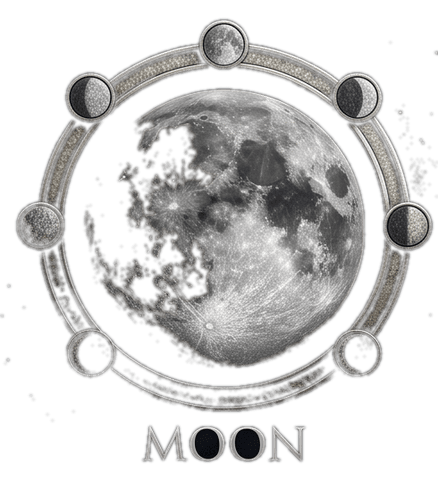
Moon
Chandra (चंद्र) — Water (Jala) Element
The mind's own mirror — karaka of the mother, emotion, and Janma Nakshatra.
Astronomical Data
- Distance from Sun
- 149.6 million km (with Earth)
- Diameter
- 3,474.8 km
- Revolution Period
- 27.32 days
- Rotation Period
- 27.32 days
- Moons
- 0
Vedic Significations
Vedic Essentials
- Guna
- Sattva-Rajas
- Presiding Deity
- Chandra Deva
- Gemstone
- Pearl (Moti)
- Metal
- Silver
Sign Dignity
Own Signs (Swakshetra)
Cancer
Exaltation (Uccha)
Taurus (3°)
Debilitation (Neecha)
Scorpio
VELS reads exclusively under the sidereal (Nirayana) zodiac and whole-sign houses — the same framework our chart engine uses to compute your own placements. Readers coming from tropical Western astrology should note that a planet's sign here refers to its sidereal position, which typically differs from its tropical sign by roughly 24°.
Navagraha Stotra — Chandra
दधिशङ्खतुषाराभं क्षीरोदार्णवसंभवम्। नमामि शशिनं सोमं शम्भोर्मुकुटभूषणम्॥
Dadhiśaṅkha tuṣārābhaṁ kṣīrodārṇava sambhavam | Namāmi śaśinaṁ somaṁ śambhormukuṭa bhūṣaṇam ||
I bow to the Moon, white as curd, conch and snow, born from the ocean of milk, the ornament adorning Lord Shiva's crown.
The Divine Journey of Chandra
In the Samudra Manthan, the churning of the cosmic ocean by devas and asuras in search of amrita, Chandra rose from the primordial waters as soma — cool and luminous where the churning itself had been fierce and heated. Shiva, taken by that coolness, placed the crescent Moon on his own head, where it still rests today, tempering the third eye's destructive fire. It is a fitting origin for the graha Vedic astrology treats as the mind's own light.
Where Surya is the soul, Chandra is manas — the emotional and instinctual mind through which every experience is filtered before it becomes thought or action. This is why the Moon's position at birth, more than any other single factor, determines the Janma Nakshatra and is treated in Vedic practice as the primary lens for reading a person's inner emotional constitution, often given more weight than the Ascendant itself in day-to-day predictive work.
Chandra completes the zodiac in just 27.32 days, the fastest-moving of all nine grahas, and classical texts read this restlessness as mirroring the mind's own constant motion. Waxing and waning through sixteen kalas across the month, the Moon models the very idea that emotional states are provisional rather than permanent — a lesson embedded directly in the myth of Chandra's twenty-seven wives, the Nakshatras themselves, whose father Daksha cursed him to wane for favoring Rohini, only for the wives to soften the curse so that he would wax again.
As karaka of the mother and of nourishment, Chandra's condition in a chart is read against the quality of that early nurturing relationship and, by extension, the native's own capacity to nurture others. A well-placed Moon is associated with emotional resilience and popularity; it governs the body's fluids broadly, and the traditional link between lunar phase and both tides and menstrual cycles is often cited as the natural-world counterpart to this rulership.
In mundane and everyday reckoning, the Moon is read as ruling public sentiment and daily rhythm rather than any single dramatic event — agricultural and fishing calendars keyed to lunar phase, and the tradition of charging water under moonlight, both draw on the same principle: that Chandra's cooling, reflective quality has a practical, embodied use, not just a symbolic one.
Discover Moon in your own birth chart — its placement, aspects, and dashas.
Get My Free Birth Chart